Overview
SKK Migas Kalsul News Intelligence is a centralized platform designed to help teams monitor and understand relevant media coverage across Kalimantan and Sulawesi.
Rather than functioning as a simple news reader, the platform operates as an end-to-end intelligence pipeline. It discovers articles from multiple configured sources, resolves and normalizes their URLs, extracts relevant content, removes duplicates, and processes the resulting information into structured intelligence.
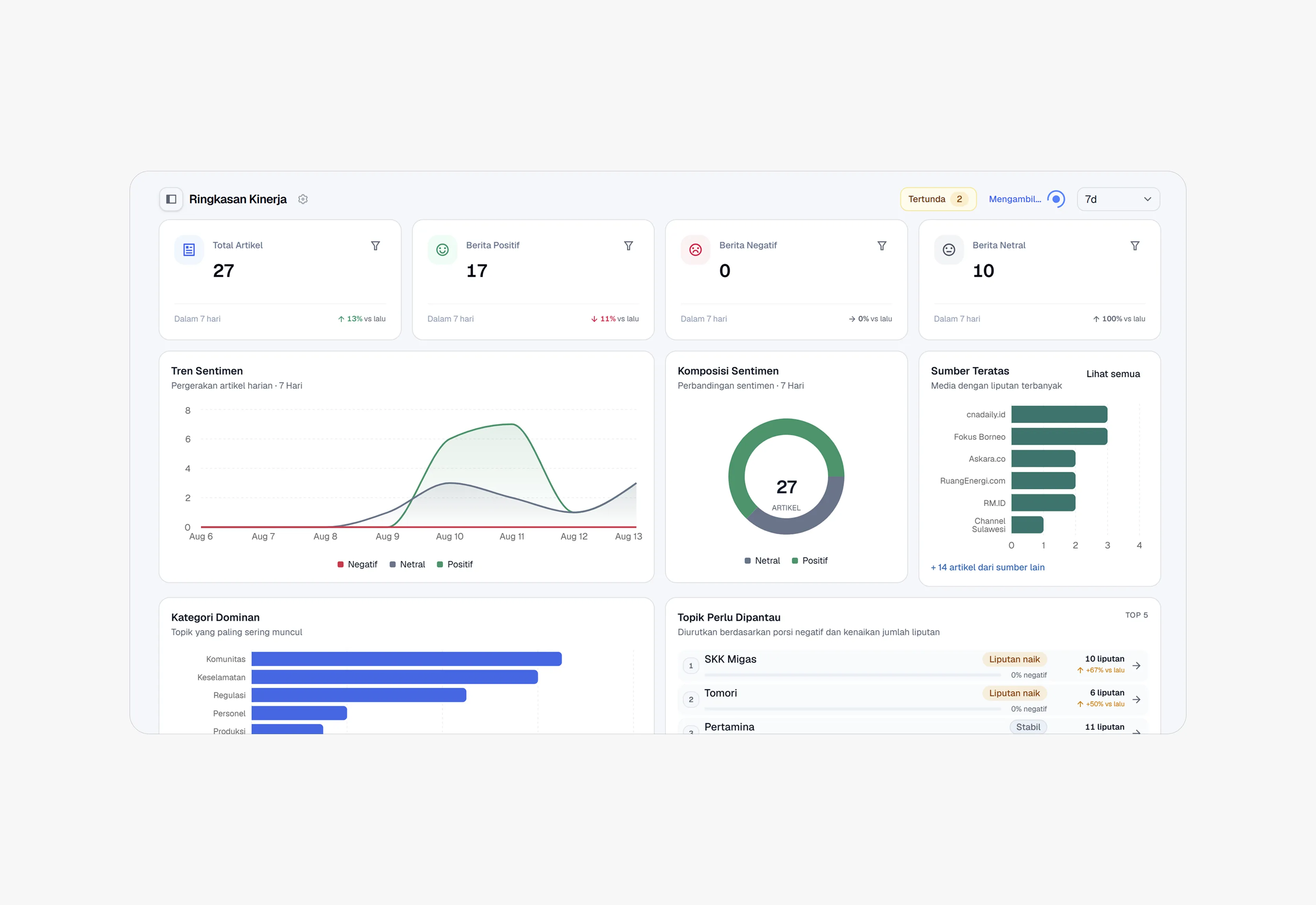
AI-assisted analysis generates concise summaries, sentiment classifications, and topic categories. The dashboard then presents coverage volume, sentiment composition, media trends, dominant categories, source distribution, and topics that may require attention.
The interface supports two complementary use cases: quick situational awareness on a shared office display and detailed investigation through a searchable article feed. Dashboard signals connect directly to their supporting articles, allowing users to move from a high-level change to the underlying evidence.
Technical Approach
The platform transforms fragmented media coverage into structured intelligence through an automated collection and analysis workflow.
A multi-source news pipeline continuously gathers relevant regional coverage. Residential proxy support improves collection reliability across publishers with different access conditions, while normalization and deduplication keep the resulting dataset consistent.
Collected articles are enriched with AI-assisted summaries, sentiment classifications, and topic groupings. Dashboard metrics and visualizations are generated from the same underlying records, maintaining consistency between high-level insights and their supporting articles.
The system was designed so users can move quickly from situational awareness to detailed investigation without needing to manage the collection or analysis process manually.
Key Features
-
Automated Multi-Source Monitoring: Continuously gathers relevant regional coverage from multiple media sources.
-
Resilient Proxy-Assisted Collection: Uses residential proxy support to improve collection reliability across different publishers and access conditions.
-
AI-Assisted Analysis: Produces concise summaries, sentiment classifications, and topic groupings to accelerate article review.
-
At-a-Glance Dashboard: Presents important coverage metrics and trends in a format suitable for individual analysis and shared office displays.
-
Rolling and Historical Analysis: Supports rolling 24-hour monitoring and longer historical periods.
-
Period Comparisons: Highlights changes in coverage and sentiment against the preceding equivalent period.
-
Topics to Watch: Surfaces topics showing notable negative sentiment, increased coverage, or sustained media attention.
-
Interactive Investigation: Connects dashboard indicators directly to their supporting filtered articles.
-
Advanced Article Discovery: Supports searching and filtering by keyword, sentiment, topic, category, source, and date.
-
Structured Reporting: Exports selected coverage into organized reports for further review and communication.
-
Processing Visibility: Communicates synchronization and analysis progress without requiring users to manage the underlying workflow.